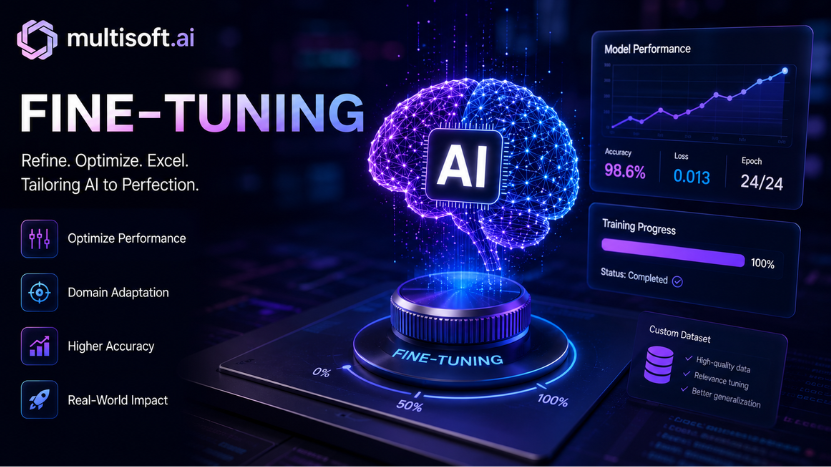
Complete Fine-Tuning Guide: Models, Frameworks, Benefits, and Best Practices
Fine-tuning has become one of the most valuable techniques in the field of Generative AI, enabling organizations to customize pre-trained artificial intelligence models for specific tasks, industries, and business requirements. Instead of building an AI model from scratch, fine-tuning enhances an existing model by training it on a smaller, domain-specific dataset. This approach significantly reduces development time, computational costs, and resource requirements while delivering more accurate, relevant, and context-aware results. As businesses increasingly adopt Large Language Models (LLMs) for applications such as customer support, healthcare, finance, legal services, software development, and content generation, fine-tuning has emerged as a critical skill for AI professionals.
Modern AI models possess extensive general knowledge, but they often require customization to understand industry-specific terminology, workflows, and organizational data. Fine-tuning bridges this gap by adapting these models to meet specialized business needs without compromising their core capabilities. Whether you are an AI engineer, data scientist, machine learning professional, software developer, or technology enthusiast, understanding fine-tuning is essential for building intelligent, high-performing AI applications. This comprehensive guide explores the fundamentals of fine-tuning, its working process, techniques, tools, benefits, challenges, real-world applications, career opportunities, and future trends to help you master one of the most in-demand skills in artificial intelligence.
What is Fine-Tuning?
Fine-Tuning Training is the process of adapting a pre-trained artificial intelligence model to perform specific tasks or solve domain-specific problems by training it on a smaller, specialized dataset. Instead of developing an AI model from the ground up, fine-tuning builds upon the knowledge already learned by a pre-trained model, enabling it to deliver more accurate, relevant, and context-aware responses. This technique is widely used with Large Language Models (LLMs), computer vision models, and speech recognition systems to improve performance in industries such as healthcare, finance, legal services, education, manufacturing, and customer support. Fine-tuning allows organizations to customize AI models for their unique business requirements, industry terminology, and workflows while significantly reducing training time, computational costs, and data requirements. By refining an existing model rather than creating a new one, businesses can rapidly deploy high-quality AI solutions that offer improved accuracy, better user experiences, and greater operational efficiency. As Generative AI continues to evolve, fine-tuning has become an essential approach for building intelligent, reliable, and enterprise-ready AI applications.
Types of Fine-Tuning
Fine-tuning can be performed using several approaches depending on the complexity of the task, available computing resources, and business objectives. Full Fine-Tuning updates all model parameters, delivering the highest level of customization but requiring significant computational power. Partial Fine-Tuning modifies only selected layers of the model, reducing training time while maintaining strong performance. Parameter-Efficient Fine-Tuning (PEFT) updates a small subset of parameters, making it a cost-effective solution for adapting large language models. Popular PEFT techniques include LoRA (Low-Rank Adaptation), which adds lightweight trainable layers, and QLoRA, which combines quantization with LoRA to reduce memory usage. Other methods such as Prompt Tuning, Prefix Tuning, and Adapter Tuning enable efficient customization with minimal changes to the original model. Organizations also use Instruction Fine-Tuning, Domain-Specific Fine-Tuning, and Task-Specific Fine-Tuning to improve model performance for specialized applications, making fine-tuning a flexible and scalable approach for developing enterprise-ready AI solutions.
Fine-Tuning Tools and Frameworks
- Hugging Face Transformers
- Hugging Face PEFT
- PyTorch
- TensorFlow
- Keras
- TRL (Transformer Reinforcement Learning)
- DeepSpeed
- Accelerate
- LangChain
- LlamaIndex
- MLflow
- Weights & Biases (W&B)
- Ollama
- NVIDIA NeMo
- Ray Train
- OpenAI Fine-Tuning API
- Google Vertex AI
- Amazon SageMaker
- Microsoft Azure AI Studio
- Docker
- Kubernetes
Fine-Tuning vs Prompt Engineering vs RAG
| Feature | Fine-Tuning | Prompt Engineering | Retrieval-Augmented Generation (RAG) |
| Purpose | Customize the AI model | Improve responses through better prompts | Enhance responses using external knowledge |
| Training Required | Yes | No | No |
| Uses External Data | During training | No | Yes |
| Cost | High | Low | Medium |
| Implementation Time | Days to weeks | Minutes to hours | Hours to days |
| Model Modification | Yes | No | No |
| Best For | Domain-specific AI applications | General AI interactions | Knowledge-intensive applications |
| Accuracy | Very High | Moderate | High |
| Scalability | High | High | High |
| Ideal Use Cases | Healthcare, finance, legal AI | Content creation, chatbots | Enterprise search, document Q&A |
Applications of Fine-Tuning
Fine-tuning is widely used to customize AI models for industry-specific tasks and business applications. Organizations fine-tune Large Language Models (LLMs) to improve customer support, automate document processing, generate personalized content, and enhance virtual assistants. In healthcare, fine-tuned models assist with medical documentation, clinical decision support, and research. Financial institutions use them for fraud detection, risk analysis, and regulatory compliance, while legal firms leverage fine-tuned AI for contract review and legal research. Fine-tuning also plays a vital role in education through personalized learning platforms, manufacturing through predictive maintenance, retail through recommendation systems, and software development by creating intelligent coding assistants. By adapting pre-trained models to domain-specific knowledge, businesses can improve accuracy, efficiency, and user experience while addressing unique operational requirements.
Challenges of Fine-Tuning
Although fine-tuning offers significant advantages, it also presents several technical and operational challenges. Training AI models requires high-performance GPUs, large memory capacity, and substantial computational resources, making the process expensive for many organizations. The success of fine-tuning depends heavily on the quality, diversity, and size of the training dataset, as poor-quality data can lead to inaccurate or biased outputs. Models may also suffer from overfitting, where they perform well on training data but poorly on unseen data. Additional challenges include catastrophic forgetting, privacy concerns, data security, copyright compliance, and model maintenance as business requirements evolve. Organizations must continuously evaluate and update fine-tuned models to maintain performance, accuracy, and compliance with changing regulations and industry standards.
Skills Required to Learn Fine-Tuning
Fine-tuning requires a strong understanding of artificial intelligence, machine learning, and modern deep learning frameworks. Learners should be comfortable with programming concepts, particularly Python, and have a solid grasp of neural networks, Natural Language Processing (NLP), and transformer architectures. Knowledge of pre-trained models, prompt engineering, transfer learning, and parameter-efficient fine-tuning techniques helps professionals build optimized AI applications. Practical experience with cloud platforms, GPU computing, model deployment, and MLOps further enhances the ability to develop scalable enterprise AI solutions. Since Generative AI evolves rapidly, continuous learning, experimentation, and hands-on projects are essential for staying current with new tools, frameworks, and best practices.
Key Skills:
- Python Programming
- Machine Learning Fundamentals
- Deep Learning
- Neural Networks
- Natural Language Processing (NLP)
- Transformer Architecture
- Hugging Face Transformers
- PyTorch or TensorFlow
- Prompt Engineering
- Parameter-Efficient Fine-Tuning (PEFT)
- LoRA and QLoRA
- Dataset Preparation
- Model Evaluation
- Cloud Computing (AWS, Azure, Google Cloud)
- MLOps and Model Deployment
- API Integration
- Git and Version Control
- Problem-Solving and Analytical Thinking
Best Practices for Fine-Tuning
Successful fine-tuning begins with selecting a high-quality pre-trained model that closely matches the intended application. Organizations should prepare clean, balanced, and representative datasets to ensure reliable learning and minimize bias. Using parameter-efficient techniques such as LoRA or PEFT can significantly reduce computational costs while maintaining excellent performance. Careful tuning of hyperparameters, continuous monitoring of training metrics, and rigorous evaluation using validation datasets help prevent overfitting and improve model accuracy. It is also important to document experiments, maintain version control, protect sensitive data, and perform regular updates as business requirements evolve. Combining fine-tuning with human feedback and continuous performance monitoring ensures that AI models remain accurate, secure, and aligned with organizational objectives.
Common Mistakes to Avoid
- Using low-quality or incomplete datasets
- Fine-tuning with insufficient training data
- Choosing an inappropriate base model
- Ignoring data preprocessing
- Overfitting the model
- Skipping validation and testing
- Using incorrect hyperparameters
- Ignoring evaluation metrics
- Not monitoring model performance after deployment
- Neglecting data privacy and security
- Forgetting model version control
- Ignoring bias in training data
- Using expensive full fine-tuning when PEFT is sufficient
- Failing to document experiments
- Not updating models as new data becomes available
Future of Fine-Tuning
The future of fine-tuning is focused on making AI model customization faster, more efficient, and accessible to organizations of all sizes. Emerging techniques such as Parameter-Efficient Fine-Tuning (PEFT), LoRA, QLoRA, and adapter-based learning are reducing computational requirements while delivering high-performance results. As multimodal AI models become more advanced, fine-tuning will extend beyond text to include images, audio, video, and structured data within a single model. Organizations will increasingly combine fine-tuning with Retrieval-Augmented Generation (RAG), AI agents, and autonomous workflows to build intelligent enterprise solutions. Advances in cloud computing, specialized AI hardware, and automated machine learning will further simplify model customization, enabling businesses to deploy domain-specific AI applications more quickly. As Generative AI adoption accelerates, fine-tuning will remain a fundamental capability for creating secure, accurate, and highly personalized AI systems.
Conclusion
Fine-tuning Certification has become a cornerstone of modern artificial intelligence, enabling organizations to adapt pre-trained models for specific industries, tasks, and business objectives. By leveraging existing AI knowledge instead of building models from scratch, businesses can reduce development time, lower costs, and achieve greater accuracy with domain-specific applications. From healthcare and finance to education, retail, and software development, fine-tuning is driving innovation across countless sectors. Although challenges such as data quality, computational requirements, and model maintenance remain, adopting best practices and modern techniques like PEFT and LoRA can significantly improve efficiency and performance. As Generative AI continues to evolve, professionals with expertise in fine-tuning will play a vital role in developing intelligent, scalable, and enterprise-ready AI solutions. Learning fine-tuning today provides a strong foundation for building the next generation of AI-powered applications and unlocking exciting career opportunities in the rapidly growing field of artificial intelligence. Enroll in Multisoft Ai now!
About the Author